

Our Processing & Grading System
Facilities utilized across our supply chain in Central Java
Indonesian Green Coffee Grading Standards (SNI 01-2907-2008)
To guarantee consistency, transparent pricing, and quality control for our international buyers, our green coffee beans are strictly graded according to the Indonesian National Standard (SNI 01-2907-2008). This framework serves as a direct enforcement mechanism for the International Coffee Organization’s (ICO) Resolution 407. We align our domestic supply with rigorous international standards—ultimately driving stronger commercial appeal and buyer confidence worldwide.
Unlike systems that rely on a flat percentage of defects by weight, the SNI system uses an accurate weighted penalty point system (Nilai Cacat) based on a standard 300-gram sample. This ensures that severe defects (which can damage roasting equipment or ruin a cup profile) are heavily penalized, while minor, purely cosmetic anomalies are scored appropriately.
When you contract a specific grade with us, you know exactly what baseline quality to expect in your container.
Commercial Grading Tiers
The SNI standard categorizes green coffee into six distinct commercial tiers based on the maximum allowable penalty points per 300g sample.
SNI Quality Grade | Total Allowable Defect Points (per 300g) |
|---|---|
Grade 1 | 0 to 11 |
Grade 2 | 12 to 25 |
Grade 3 | 26 to 44 |
Grade 4a | 45 to 60 |
Grade 4b | 61 to 80 |
Grade 5 | 81 to 150 |
Grade 6 | 151 to 225 |
Defect Point Calculation Table (Nilai Cacat)
Every defect found within the 300-gram sample is isolated and assigned a specific penalty value. If a single bean has multiple defects, it is only scored once based on its most severe flaw. The sum of these points dictates the final Grade classification of the lot.
Minor Defects (Cosmetic & Insect Damage)
SNI Defect Category | Physical Defect Count | Penalty Point Value |
|---|---|---|
Medium Parchment Husk | 1 piece | 1/5 point (0.2) |
Broken Bean (Biji Pecah) | 1 bean | 1/5 point (0.2) |
Immature Bean (Biji Muda) | 1 bean | 1/5 point (0.2) |
Insect Damaged (>1 hole) | 1 bean | 1/5 point (0.2) |
Small Parchment Husk | 1 piece | 1/10 point (0.1) |
Insect Damaged (1 hole) | 1 bean | 1/10 point (0.1) |
Spotted Bean (Wet Process only) | 1 bean | 1/10 point (0.1) |
Small Coffee Husk | 1 piece | 1/5 point (0.2) |
Moderate Defects (Partial Damage & Discoloration)
SNI Defect Category | Physical Defect Count | Penalty Point Value |
|---|---|---|
Broken Black Bean | 1 bean | 1/2 point (0.5) |
Medium Coffee Husk | 1 piece | 1/2 point (0.5) |
Bean in Parchment (Berkulit Tanduk) | 1 bean | 1/2 point (0.5) |
Large Parchment Husk | 1 piece | 1/2 point (0.5) |
Brown Bean (Biji Coklat) | 1 bean | 1/4 point (0.25) |
Partial Black Bean | 1 bean | 1/2 point (0.5) |
Severe Defects (Foreign Matter & Black Beans)
SNI Defect Category | Physical Defect Count | Penalty Point Value |
|---|---|---|
Large Stone, Twig, or Soil (>10mm) | 1 piece | 5 points |
Medium Stone, Twig, or Soil (5mm - 10mm) | 1 piece | 2 points |
Small Stone, Twig, or Soil (<5mm) | 1 piece | 1 point |
Full Black Bean | 1 bean | 1 point |
Coffee Pod / Unhulled Bean (Gelondong) | 1 pod | 1 point |
Large Coffee Husk | 1 piece | 1 point |

Coffee Plantation in Central Java
Hundreds of hectares of coffee plantations on the slopes of Muria Mountain in Kudus have been one of the largest sources of Robusta coffee in Central Java. The area has been known for its quality since the Dutch colonial era, 350 years ago.
Versatile Variation of Robusta Coffee
The main coffee varieties grown in the Kudus area are BP21 and Tugu Sari. Their versatility has been proven, resulting in high yields every year.


Indoor Drying Facility
As the natural process requires a lot of heat and sunshine for drying, we utilize an indoor drying facility (greenhouse) to ensure that our beans achieve optimal drying.
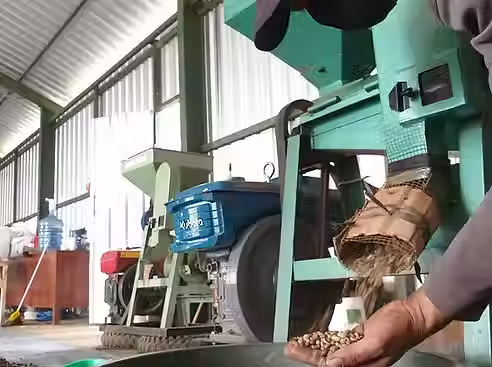
Hulling Process
After the coffee has been dried, the next process is hulling. Using this machinery, we separate the dried coffee cherry skin and flesh to obtain the green coffee beans.

Size Screening
We utilize VNT Size Screening Machine to do the first sortation process.
Optical Sorting Process
Second QC pass: a high-capacity AI optical sorter removes defects. In this process, we utilize Vision High Speed Conveyor + Deep Learning XT2 series (+/-1500 KG/H)
.jpg)

2nd Stage Optical Sorting (Optional)
A second machine catches misses & corrects bias for Grade 1. In this process, we utilize Wesort 6SXZ-136 (750 KG/H)